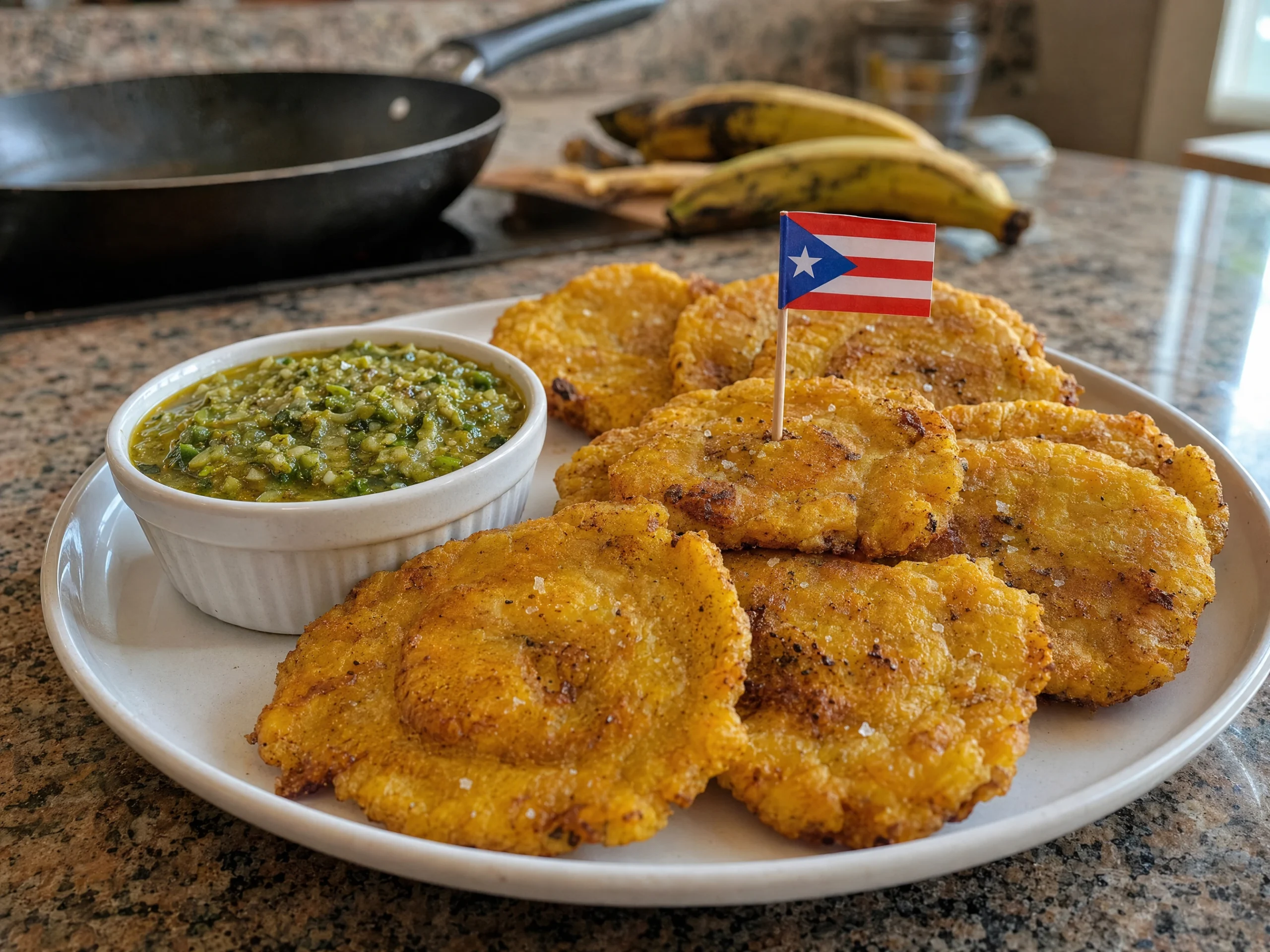
Tostones con Ajilimójili (Puerto Rican Fried Plantains with Garlic-Pepper Sauce)
LOCAL NAME NOTE
Some Puerto Rican families call the sauce simply “mojo” or “ajilí mojili” as one word. It’s also easy to confuse with two other popular tostón sauces: mojo de ajo (a plain garlic-and-olive-oil dip, no peppers) and tostones al ajillo (tostones tossed in garlic butter, a specialty of Puerto Rico’s Chinese restaurants). Ajilimójili is its own thing — a blended sauce built on ajíes dulces (sweet Caribbean peppers), garlic, and cilantro.
THE STORY BEHIND THE RECIPE
Tostones show up at almost every Puerto Rican table — alongside rice and beans, stacked next to a plate of pernil, or served solo as a snack with a cold Malta. Ajilimójili is the sauce that takes them from good to memorable. It’s not hot sauce in the way people expect; ajíes dulces (the small sweet peppers used across the island) bring flavor without much heat, so the sauce reads as savory and a little tangy rather than spicy. If you can’t find ajíes dulces where you live, this recipe includes an easy substitution that still gets you very close to the real thing.
WHAT DOES IT TASTE LIKE?
The tostones themselves are crispy on the outside, soft and slightly starchy inside — closer to a savory chip than anything sweet. The ajilimójili is garlicky and herbal from the cilantro, with a bright kick from vinegar and a gentle background warmth if you include the optional hot pepper. Together, it’s salty, crunchy, and a little tangy — the kind of side dish people reach for again before their plate is empty.
WHY YOU SHOULD TRY IT
If you’ve only ever had tostones with mayo-ketchup, ajilimójili is worth the extra ten minutes. It’s the more traditional pairing, it keeps things dairy-free and lighter, and it doubles as a sauce for grilled meats, roasted yuca, or pasteles — so you’ll get more than one use out of the batch.
HELPFUL RECIPE TIPS
- Use plantains that are fully green and firm. Any yellowing means the starch is converting to sugar, and the plantain won’t crisp up the same way.
- Don’t skip the flattening step or the second fry — the first fry cooks the plantain through, the second one is what makes them crispy.
- Keep oil temperature steady. Too hot and the outside burns before the inside cooks; too cool and the tostones turn greasy instead of crisp.
- If ajíes dulces aren’t available, mini sweet bell peppers are the closest substitute in flavor and mildness.
- Salt the tostones right after they come out of the oil, while they’re still hot — the salt sticks better.
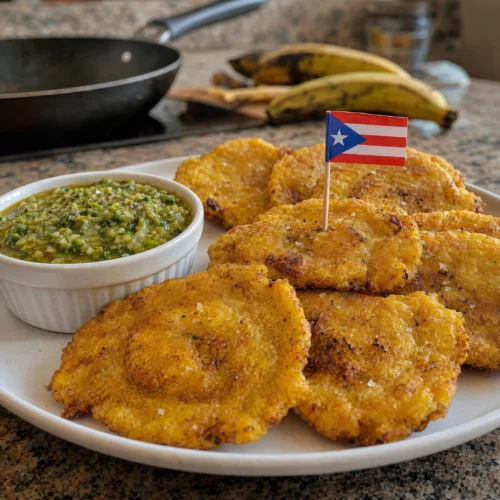
Tostones con Ajilimójili
Equipment
- Large heavy skillet or deep frying pan
- Tostonera, or two small plates / bottom of a glass
- Food processor or blender
- Small saucepan
- Slotted spoon
- Paper towels or wire rack
Ingredients
For the tostones
- 3 large green plantains fully unripe (about 1.5 lbs / 680 g)
- 2 cups 475 ml vegetable or canola oil, for frying
- 1 teaspoon 5 g fine sea salt, for seasoning after frying
For the ajilimójili sauce
- 6 ajíes dulces stemmed and seeded (or 4 mini sweet bell peppers as a substitute)
- 1 small cubanelle or green bell pepper seeded and roughly chopped
- 4 garlic cloves peeled
- 1/2 cup 15 g fresh cilantro leaves
- 1/4 of a small habanero or ají picante seeded (optional, for heat)
- 1/3 cup 80 ml extra-virgin olive oil
- 2 tablespoons 30 ml white vinegar or fresh lime juice
- 1/2 teaspoon 3 g salt, plus more to taste
- 1/4 teaspoon 0.5 g black pepper
- Pinch of dried oregano optional
Instructions
Make the ajilimójili sauce
- In a small saucepan over low heat, warm the chopped ajíes dulces, cubanelle pepper, and garlic cloves in 2 tablespoons of the olive oil for about 5 minutes, stirring occasionally, until the peppers soften slightly. Remove from heat and let cool for 5 minutes.
- Transfer the softened peppers and garlic to a food processor or blender. Add the cilantro, optional habanero, vinegar or lime juice, salt, black pepper, oregano, and the remaining olive oil.
- Blend until mostly smooth, with a little texture remaining, about 30 seconds. Taste and adjust salt or vinegar as needed. Set aside at room temperature while you make the tostones.
Make the tostones
- Cut off both ends of each plantain. Make a shallow lengthwise slit through the peel only, then peel away the skin with your fingers or a knife.
- Slice the peeled plantains into rounds about 1 to 1.5 inches thick.
- Heat the frying oil in a large skillet over medium heat until it reaches 325°F (163°C). The oil is ready when a small piece of plantain dropped in sizzles gently.
- Fry the plantain rounds in batches, without crowding the pan, for 2 to 3 minutes per side, until pale golden and just softened. Remove with a slotted spoon and drain on paper towels.
- Let the fried plantains cool for 2 to 3 minutes, then flatten each piece to about 1/2 inch thick using a tostonera, or by pressing between two small plates.
- Increase the oil temperature to 350°F (177°C). Return the flattened plantains to the oil in batches and fry again for 2 to 3 minutes per side, until deep golden and crisp.
- Remove with a slotted spoon, drain on fresh paper towels or a wire rack, and sprinkle immediately with salt while hot.
- Serve warm with the ajilimójili sauce on the side for dipping.
Notes
- Substitution: If ajíes dulces aren’t sold near you, mini sweet bell peppers are the closest stand-in — they’re mild and slightly sweet like the original.
- Heat level: The habanero is optional. Leave it out entirely for a sauce with no heat, which is common in many households.
- Salt guidance: Because the tostones are salted after frying and the sauce already contains salt, avoid adding extra adobo or seasoned salt on top unless you cut back the salt elsewhere.
- Storage: Ajilimójili keeps in an airtight container in the refrigerator for up to 5 days. Tostones are best eaten fresh — they lose their crispness within an hour or two.
- Make-ahead: You can do the first fry and flattening step up to a day ahead. Refrigerate the flattened plantains, then do the second fry just before serving.